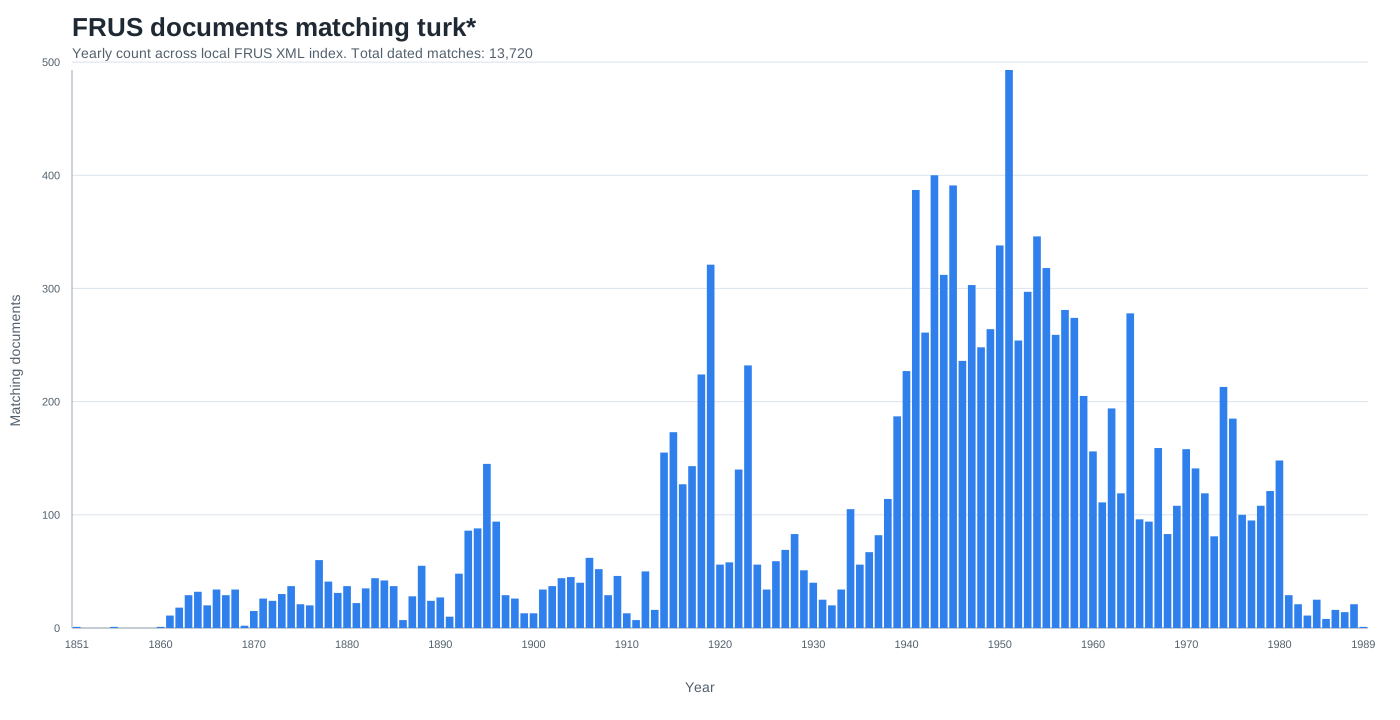
Long-form archive reading guide generated from the local FRUS SQLite index. Each lead has a summary, an extracted “What the document contains” passage, and the result/meaning so you can skim before opening full documents.
Late Ottoman, 1871-1913
This era shows the Ottoman Empire through U.S. diplomatic eyes as a still-sovereign but increasingly pressured empire. The archive is rich on Straits law, missionary protection, Armenian violence, naturalized Ottoman-born Americans, Macedonia, Crete, Young Turk constitutionalism, and the Balkan Wars. It is less a single story than a set of fractures: foreign legal privileges, minority violence, reform promises, and Great Power pressure all accumulating before WWI.
1. Straits settlement after London
The U.S. minister in Constantinople explains why the Bosphorus and Dardanelles matter after the London conference. He lays out the restrictions on navigation and the diplomatic logic behind them. This gives the long prehistory of the Straits problem that later returns at Lausanne, Montreux, WWII, and the Cold War.
What the document contains
No. 404. Mr. MacVeagh to Mr. Fish. No. 23.] Legation of the United States , Constantinople , January 24, 1871 . (Received February 22.) Sir: In view of the conference now in session at London, and the prominence which has been recently given to the restrictions affecting the navigation of the Straits of the Bosphorus and the Dardanelles, it has occurred to me that you might desire to possess, in the convenient form of a dispatch, a statement as well of the restrictions themselves, as of the grounds on which they are rested. In any view of this question a primary consideration is the grave importance attached immemorially to the geographical peculiarities of the situation of Constantinople. On the west the narrow Straits of the Dardanelles connect the sea ...
Result / why it matters
The U.S. minister in Constantinople explains why the Bosphorus and Dardanelles matter after the London conference. He lays out the restrictions on navigation and the diplomatic logic behind them. This gives the long prehistory of the Straits problem that later returns at Lausanne, Montreux, WWII, and the Cold War.
Back to top
2. British fleet and Dardanelles crisis
During the Russo-Turkish crisis, British ironclads approach the Straits and public anxiety rises in Constantinople. The dispatch captures the city as a pressure chamber: Russia advancing, Britain maneuvering, and Ottoman authority being tested at the empire’s most sensitive waterway.
What the document contains
No. 504. Mr. Maynard to Mr. Evarts . Legation of the United States , Constantinople , February 15, 1878 . (Received March 12.) No. 224.] Sir : For several days past there has been in the city much anxiety and public excitement. In a recent dispatch, No. 219, I mentioned the movement of the British fleet from Besika Bay to the entrance of the Dardanelles. On the 10th instant the fleet was announced once more, and its arrival expected that day. It did not come as anticipated, and it was derisively placarded as lost. This morning, however, four ironclads arrived off the Bosphorus and anchored at the Prince’s Islands. Five more ships are reported inside the Straits, making a fleet of nine vessels near at hand, and it is understood against the protest of t ...
Result / why it matters
During the Russo-Turkish crisis, British ironclads approach the Straits and public anxiety rises in Constantinople. The dispatch captures the city as a pressure chamber: Russia advancing, Britain maneuvering, and Ottoman authority being tested at the empire’s most sensitive waterway.
Back to top
3. Naturalized Ottoman-born Americans
A Greek-Ottoman-born naturalized American raises the old empire-versus-passport problem. The U.S. wants to protect naturalized citizens; the Ottoman state resists losing jurisdiction over former subjects. This is one of the most useful veins for migration, citizenship, identity, and protection stories.
What the document contains
... at after receiving the telegram referred to in my No. 277, Not printed. of the 1st instant, announcing the absence of Seferiades from Smyrna, I received a letter from him, which announced the settlement of his difficulties with the kindred of the boy who was killed and which shows his anxiety to know how far he can be protected. His letter is inclosed herewith. I have been unavoidably delayed in going to Smyrna, but deemed it both prudent and necessary to visit the Sublime Porte before answering the letter. Being of Greek ancestry, through an Ottoman subject by birth, the agreement with the Porte that naturalized citizens of the United States who were by birth Armenians might be excluded when they return, on account of their revolutionary societies in America, does not apply in his case. No seditious societies are known to exist among the Greeks. I append a brief memorandum of my interviews with Said Pasha, minister of foreign ...
Result / why it matters
A Greek-Ottoman-born naturalized American raises the old empire-versus-passport problem. The U.S. wants to protect naturalized citizens; the Ottoman state resists losing jurisdiction over former subjects. This is one of the most useful veins for migration, citizenship, identity, and protection stories.
Back to top
4. Armenian violence and missionary losses
The State Department reports to the U.S. Senate on injuries to American citizens and property in Turkey, and on oppression or cruelties against Armenian subjects of the Ottoman government. It ties congressional pressure, missionary networks, consular reporting, and Ottoman responsibility into one document trail.
What the document contains
... sident : The undersigned, Secretary of State, has had the honor to receive, by reference from the President, a resolution adopted in the Senate of the United States on December 4, 1895, as follows: Resolved , That the President he requested, if in his judgment not incompatible with the public interest, to communicate to the Senate all information which has been received by him or by the State Department in regard to injuries indicted upon the persons or property of American citizens in Turkey, and in regard to the condition of affairs there in reference to the oppression or cruelties practiced upon the Armenian subjects of the Turkish Government; also, to inform the Senate whether all the American consuls in the Turkish Empire are at their posts of duty, and if not, to state any circumstances which have interfered with the performance of the duties of such consuls. In compliance with the direction of the President, the undersi ...
Result / why it matters
The State Department reports to the U.S. Senate on injuries to American citizens and property in Turkey, and on oppression or cruelties against Armenian subjects of the Ottoman government. It ties congressional pressure, missionary networks, consular reporting, and Ottoman responsibility into one document trail.
Back to top
5. Missionary school at Marash burned
A short telegram reports the burning of the missionary school at Marash, delayed protection, and related destruction around Harpoot. The value here is concreteness: named places, destroyed institutions, delayed security, and missionaries caught in local violence.
What the document contains
Mr. Terrell to Mr. Olney . [Telegram.] Constantinople , November 27, 1895 . Missionary school of science at Marash burned 19th and telegram delayed. Missionaries safe; protection furnished eight hours after burning. Aintab College protected. JBarnum telegraphs buildings at Harpoot were set on fire separately by Koords and citizens, in presence of soldiers, in Armenian rioting. Houses of Allen, Browne, Wheeler, ladies’ house, chapel, boarding house, girls’ theological school, seminary building, worth $44,000, burned; personal property, $33,0 ...
Result / why it matters
A short telegram reports the burning of the missionary school at Marash, delayed protection, and related destruction around Harpoot. The value here is concreteness: named places, destroyed institutions, delayed security, and missionaries caught in local violence.
Back to top
6. Macedonia outbreak
The U.S. legation watches Macedonia become alarming and warns American missionaries and business interests. This shows how Ottoman European provinces became a security and humanitarian concern before the Balkan Wars.
What the document contains
Mr. Leishman to Mr. Hay . Legation of the United States , Constantinople , September 19, 1903 . No. 576.] Sir : The troubles continue to multiply, and I very much fear that ere this reaches you the outbreak in Macedonia will have assumed rather alarming proportions. As precautionary measures, I have addressed a note to the representatives of the missionaries and the American Tobacco Trust, the only two interests that I have any knowledge of as having American citizens located in the Macedonian district, advising the withdrawal of all those who are not actually needed to safeguard their interests until peace and order be again restored. Fortunately there are le ...
Result / why it matters
The U.S. legation watches Macedonia become alarming and warns American missionaries and business interests. This shows how Ottoman European provinces became a security and humanitarian concern before the Balkan Wars.
Back to top
7. Bible distribution and Ottoman restrictions
The American Bible Society becomes a diplomatic issue. The Porte accepts free Bible sales in principle but constrains the actual practice. It is a compact story about censorship, missionary publishing, religious liberty, and Ottoman administrative control.
What the document contains
Minister Leishman to the Secretary of State . American Legation , Constantinople , February 16, 1906 . No. 1290.] Sir : I have to acknowledge the receipt of your No. 967 of January 6, 1906, inclosing copy of a letter addressed to the department by the American Bible Society regarding colportage of the Bible in Turkey. The Sublime Porte, while admitting in principle the free and unrestricted sale of the Bible in Turkey, imposes certain regulations which interfere somewhat with the free movements of the colporteurs, who are treated upon the same basis as peddlers of other articles, who are compelled to secure a local license. Theoretically no reasonable objection could be offered against this general regulation, but in prac ...
Result / why it matters
The American Bible Society becomes a diplomatic issue. The Porte accepts free Bible sales in principle but constrains the actual practice. It is a compact story about censorship, missionary publishing, religious liberty, and Ottoman administrative control.
Back to top
8. Young Turk constitutional restoration
The U.S. receives news of constitutional restoration, amnesty, and political prisoners. This captures the hopeful Young Turk moment, before the empire’s final decade of wars and territorial collapse.
What the document contains
File No. 10044/74. Ambassador Leishman to the Secretary of State . [Telegram.—Paraphrase.] American Embassy , Constantinople , July 28, 1908 . (Mr. Leishman reports that general amnesty for all political prisoners has been proclaimed, and those imprisoned are being released Says that dissatisfaction with the old régime was so general that the change has been brought about with comparatively little bloodshed, but as the demands of the liberated masses increase daily, serious troubles are likely to ensure, as the constitution granted at the beginning of the present reign, which has once more been put in force, is quite limited in character, a ...
Result / why it matters
The U.S. receives news of constitutional restoration, amnesty, and political prisoners. This captures the hopeful Young Turk moment, before the empire’s final decade of wars and territorial collapse.
Back to top
9. Crete after Young Turk revolution
Crete remains unresolved even after constitutional reform. The protecting powers, Ottoman government, and Greek unionist pressure collide, showing that Ottoman reform could not easily contain nationalist territorial questions.
What the document contains
File No. 871/20–23. Minister Moses to the Secretary of State . [Extract.] American Legation , Athens , July 16, 1909 . No. 6—Greek Series.] Sir : I have the honor to report that the note of the four protecting powers, in re the Cretan situation, was delivered at the Greek ministry for foreign affairs on Tuesday, the 13th instant, and to inclose a copy of the document, with an English translation. I have, etc., Geo. H. Moses. [Inclosure 1–Translation.] communication made unofficially and verbally to the greek ministry fob foreign affairs by the representatives of great britain, france, italy, and russia, july 13, 1909. The Governments of France, Great Britain, I ...
Result / why it matters
Crete remains unresolved even after constitutional reform. The protecting powers, Ottoman government, and Greek unionist pressure collide, showing that Ottoman reform could not easily contain nationalist territorial questions.
Back to top
10. Balkan War and European Turkey reforms
At the opening of the Balkan War, the Ottoman government acknowledges reform needs in European Turkey. The document reads as reform arriving at the edge of collapse: the state recognizes the problem as military events overtake diplomacy.
What the document contains
File No. 767.70/26. [Untitled] American Embassy , Constantinople , October 14, 1912 . The reply of the Turkish Government to the joint note of the Ambassadors says that the necessity for reforms in European Turkey had already been recognized, and that the Turkish Government expects to apply them without foreign interference; that if attempts at reform heretofore made have failed it is due to the disturbing machinations of agitators whose object is apparent; that the Turkish Government is grateful for the friendly intention of the Powers and will associate itself with ...
Result / why it matters
At the opening of the Balkan War, the Ottoman government acknowledges reform needs in European Turkey. The document reads as reform arriving at the edge of collapse: the state recognizes the problem as military events overtake diplomacy.
Back to top
WWI, Collapse, and Independence, 1914-1923
This is the richest dramatic era in the FRUS Turkey corpus. The Ottoman Empire enters total war, Armenian suffering becomes an international diplomatic issue, the empire requests armistice, Constantinople is occupied, Paris debates partition and mandates, Smyrna becomes the hinge of Greek-Turkish conflict, and Ankara replaces Istanbul as the real center of Turkish power. The documents are not neutral omniscience; they are U.S. diplomatic records, often shaped by missionary, Allied, consular, and humanitarian channels. But as first-hand policy records, they are extremely valuable.
1. Armenian atrocities enter Allied diplomacy
The document records Allied diplomatic language around Armenian suffering and Ottoman responsibility. It is a key entry point into wartime atrocity reporting, Kurdish/local violence references, Ottoman policy, and the later peace-conference treatment of Armenia.
What the document contains
File No. 867.4016/67 The Ambassador in France ( Sharp ) to the Secretary of State [Telegram] Paris , May 28, 1915, 11 a. m. [ Received 8 p. m. ] 796. Foreign Office note just received transmits a communication requesting that it be notified urgently to Ottoman Government as follows: May 24. For about a month the Kurd and Turkish population of Armenia has been massacring Armenians with the connivance and often assistance of Ottoman authorities. Such massacres took place in middle April (new style) at Erzerum, Dertchun, Eguine, Van, Bitlis, Mush, Sassun, Zeitun, and throughout Cilicia. Inhabitants of about one hundred villages near Van were all murdered. In that city Armenian quarter is besieged by Kurds. At the sam ...
Result / why it matters
The document records Allied diplomatic language around Armenian suffering and Ottoman responsibility. It is a key entry point into wartime atrocity reporting, Kurdish/local violence references, Ottoman policy, and the later peace-conference treatment of Armenia.
Back to top
2. Ottoman request for armistice
The Ottoman government seeks a general armistice on land and sea. This is the hinge from wartime empire to defeated empire: after this, the archive turns to occupation, partition, mandates, refugees, and resistance.
What the document contains
... esident the note which you addressed to him on the 14th instant, Ante , p. 359 . and handed to me on that date. Acting under the instructions of your Government, you enclosed with that note the text of a communication received by the Minister for Foreign Affairs of Spain from the Chargé d’Affaires of Turkey at Madrid on October 12, in which the good offices of the Government of Spain were sought to bring to the attention of the President the request of the Imperial Ottoman Government that he take upon himself the task of the reestablishment of peace, and that he notify all belligerent states of the request, and invite them to delegate plenipotentiaries to initiate negotiations, the Imperial Ottoman Government accepting as a basis for the negotiations the program laid down by the President in his message to Congress of January 8, 1918, and in his subsequent declarations, especially his speech of September 27. It is further requ ...
Result / why it matters
The Ottoman government seeks a general armistice on land and sea. This is the hinge from wartime empire to defeated empire: after this, the archive turns to occupation, partition, mandates, refugees, and resistance.
Back to top
3. Occupation of Constantinople debate
Allied powers debate occupation and control of Constantinople after the armistice. The city is capital, symbol, military position, and gateway to the Straits all at once.
What the document contains
763.72119/3147 The British Embassy to the Department of State Copy of Telegram From the Foreign Office to His Majesty’s Ambassador at Rome, Dated December 13 th While in London the Italian Minister for Foreign Affairs communicated a memorandum containing the following statements:— 1. That a strong contingent of the Italian 35th Division should be despatched to Constantinople in accordance with the agreement for the International occupation of that town which was settled some time ago. 2. That if Turkey continues non-compliance with the terms of the Armistice regarding Tripolitania, Italy will on her own account proceed to occupy some locality in Anatolia to which she is entitled, in accordance with the Inter-Allied agreement regarding Turkey. As regards 1. You should inform the Italian Government that there has never been ...
Result / why it matters
Allied powers debate occupation and control of Constantinople after the armistice. The city is capital, symbol, military position, and gateway to the Straits all at once.
Back to top
4. Paris Peace Conference Ottoman settlement
Peace Conference discussion treats the Ottoman Empire as a defeated state open to major redesign. This is the diplomatic environment that produces Sèvres and provokes the legitimacy split with Turkish nationalists.
What the document contains
Paris Peace Conf. 180.03101/29 BC–22 Secretary’s Notes of a Conversation Held in M. Pichon’s Room at the Quai d’Orsay, Paris, on Tuesday, 4 February, 1919, at 11 O’clock a.m. Paris , February 4, 1919, 11 a.m. Present America, United States of President Wilson Mr. R. Lansing Mr. A. H. Frazier Mr. L. Harrison Lieut. Burden British Empire The Rt. Hon. D. Lloyd George, M. P. The Rt. Hon. A. J. Balfour, M. P. Gen. The Rt. Hon. Louis Botha Lt. Col. Sir M. P. A. Hankey Major A. ...
Result / why it matters
Peace Conference discussion treats the Ottoman Empire as a defeated state open to major redesign. This is the diplomatic environment that produces Sèvres and provokes the legitimacy split with Turkish nationalists.
Back to top
5. Smyrna and Greek claims
The Great Powers discuss whether Smyrna and adjacent districts should be united to Greece. This is the prelude to Greek occupation, Turkish nationalist resistance, and the catastrophe of 1922.
What the document contains
Paris Peace Conf. 180.03401/10½ CF–10A Notes of a Meeting Held at President Wilson’s House, Place des Etats-Unis, Paris, on Tuesday, May 13, 1919, at 4 p.m. Paris , May 13, 1919, 4 p.m. Present United States of America President Wilson. British Empire Rt. Hon. D. Lloyd George, M. P. France M. Clemenceau. Sir Maurice Hankey, K. C. B.— Secretary . Professor P. J. Mantoux.— Interpreter. 1. The Germans and the Peace Treaty M. Clemenceau said that three of the German Plenipotentiaries had left for Berlin, saying that they would not sign, but Herr Brockdorff-Rantzau, according to his information, said there was no way of avoiding it. Mr. Lloyd George drew attent ...
Result / why it matters
The Great Powers discuss whether Smyrna and adjacent districts should be united to Greece. This is the prelude to Greek occupation, Turkish nationalist resistance, and the catastrophe of 1922.
Back to top
6. American mandate study for Turkey and Armenia
American officials examine possible mandates over Turkey/Armenia/Anatolia. The document is valuable because it shows how real the U.S. mandate question was before Washington retreated from responsibility.
What the document contains
Paris Peace Conf. 181.9102/9 Report of the American Section of the International Commission on Mandates in Turkey Paris , August 28, 1919 . Section One —Report upon Syria. Section Two —Report upon Mesopotamia. Post p. 799 . Section Three —Report upon the non-Arabic-Speaking Portions of the Former Ottoman Empire. Post , p. 802 . Submitted by the Commissioners: Charles K. Crane Henry Churchill King section one. the report upon syria For confidential appendix to this report, “for the use of Americans only,” see p. 848 . The American Commissioners of the projecte ...
Result / why it matters
American officials examine possible mandates over Turkey/Armenia/Anatolia. The document is valuable because it shows how real the U.S. mandate question was before Washington retreated from responsibility.
Back to top
7. Harbord Mission and Kemalist reality
The Harbord Mission is a major U.S. attempt to understand Armenia, Anatolia, mandates, and the emerging nationalist movement. It mentions Mustapha Kemal and Sivas, making it a bridge between humanitarian settlement and the reality of Turkish resistance.
What the document contains
Peace Commission files: 184.02102/5 The Chief of the Military Mission to Armenia ( Harbord ) to the Secretary of State Text here printed is that of the signed original left by Major General Harbord with the Commission to Negotiate Peace, at Paris. An unsigned copy of the report, with the exhibits and appendices, was transmitted by Major General Harbord at Washington to the Secretary of State, Nov. 14, 1919 (File No. 860j.01/575). On Board U.S.S. “ Martha Washington ” , October 16, 1919 . The undersigned submits herewith the Report of the ...
Result / why it matters
The Harbord Mission is a major U.S. attempt to understand Armenia, Anatolia, mandates, and the emerging nationalist movement. It mentions Mustapha Kemal and Sivas, making it a bridge between humanitarian settlement and the reality of Turkish resistance.
Back to top
8. Nationalists reject Constantinople treaty
Bristol reports that Turkish Nationalists do not recognize the treaty signed by the Constantinople government. This is the dual-sovereignty story: legal Ottoman authority versus effective nationalist power.
What the document contains
760j.6715/23: Telegram The High Commissioner at Constantinople ( Bristol ) to the Secretary of State Constantinople , September 18, 1920—5 p.m. [Received September 19—9:27 p.m.] 493. Section 2. Telegram in three sections; sections 1 and 3 not printed. The Nationalist movement was organized as a protest against the Greek occupation of Smyrna, and to resist any similar aggression of the Armenians in the eastern vilayet[s]. This feeling against the Greeks has been increased, and is the only thing that could have hel ...
Result / why it matters
Bristol reports that Turkish Nationalists do not recognize the treaty signed by the Constantinople government. This is the dual-sovereignty story: legal Ottoman authority versus effective nationalist power.
Back to top
9. Turkey-Armenia frontier and Kurdish districts
The U.S. position on the Turkey-Armenia frontier touches sea access, demilitarization, and Kurdish/Turkish districts. It is a map-making document where diplomatic lines carry massive human consequences.
What the document contains
760j.6715/61 The Secretary of State to the Ambassador in France ( Wallace ) Washington , November 24, 1920 . No. 671 Sir : Referring to your despatch No. 1722 of October 19th, 1920, Not printed. and in confirmation of my telegram No. 1653, November 23, 3 P.M., Not printed. I beg to enclose herewith the original text of the President’s decision respecting the frontier between Turkey and Armenia, access for Armenia to the sea, and the demilitarization of Turkish territory adjacent to the Armenian frontier. This document consists of a covering letter addressed to the President of the Supreme Council, followed by the actual decision, which comprises a technical description of the boundary and which is accompanied by two maps, one showing the boundary in general and one in sections showing the boundary in detail. Map showing ...
Result / why it matters
The U.S. position on the Turkey-Armenia frontier touches sea access, demilitarization, and Kurdish/Turkish districts. It is a map-making document where diplomatic lines carry massive human consequences.
Back to top
10. Smyrna fire aftermath
The U.S. asks about protest over killings and terrorization in Smyrna after the fire. This is a dark consular/humanitarian vein: refugees, violence, accountability, and the limits of American response.
What the document contains
... re? (4) What is your estimate of the number of the Christian minorities at present in territory in Anatolia under Turkish occupation? (5) What is your estimate of present population of eastern Thrace, exclusive of Constantinople, the proportion of Christians and the number of persons who will leave this territory previous to re-occupation by Turkey? (6) Department has now received mail reports through you, Consul General Horton, and Vice-Consul Barnes regarding the Smyrna fire. Not printed. It appears that three American citizens lost their lives, that American relief workers were robbed and threatened, that American sailors guarding the International College were attacked. What action, if any, was taken by American representatives in Smyrna to protest to Turkish authorities against such acts and to prevent their recurrence? (7) Press reports indicate that at one moment during Smyrna fire British naval forces warned the Turkis ...
Result / why it matters
The U.S. asks about protest over killings and terrorization in Smyrna after the fire. This is a dark consular/humanitarian vein: refugees, violence, accountability, and the limits of American response.
Back to top
11. Bristol on Greek and Armenian populations
Bristol reports on Nationalist policy toward Greek and Armenian populations. This is central for population removal, exchange, and postwar settlement, but it must be read carefully in full because the subject is highly charged and context-sensitive.
What the document contains
867.4016/741: Telegram The High Commissioner at Constantinople ( Bristol ) to the Secretary of State Constantinople , November 19, 1922—11 a.m. [Received 8:23 p.m.] 338. Department’s telegram number 253, November 10, 6 p.m. Not printed. and my telegram number 356[ 326 ], November 15, noon. Latest information makes me certain that Nationalist Government wishes to get rid of entire Greek and Armenian population of Anatolia and Constantinople and would like to have this a fait accompli or at least well under way before question of minorities arises at the conference. Lausanne Conference. The Turkish feeling is that the presence of these people has offered most of the pretexts in the past for the political inroads of Western powers and further inroads of this sort are abhorrent to the newly awak ...
Result / why it matters
Bristol reports on Nationalist policy toward Greek and Armenian populations. This is central for population removal, exchange, and postwar settlement, but it must be read carefully in full because the subject is highly charged and context-sensitive.
Back to top
12. Lausanne Straits negotiations
Lausanne negotiations show Turkish and Soviet positions over whether the Straits should be open or closed to warships. This connects sovereignty, security, Soviet policy, and the remaking of the post-Ottoman order.
What the document contains
767.68119T&M/36: Telegram The Special Mission at Lausanne to the Secretary of State [Paraphrase] Lausanne , December 6, 1922—9 p.m. [Received December 7—1:57 a.m.] 67. Our statement on Straits today was agreed upon by all of us after we had had separate conferences last night with Curzon and Ismet, both of whom indicated that there was some danger that the Turks would go over to the Soviet proposal that the Straits be closed to all warships and that Turkey be allowed to fortify the Straits. Of course this would le ...
Result / why it matters
Lausanne negotiations show Turkish and Soviet positions over whether the Straits should be open or closed to warships. This connects sovereignty, security, Soviet policy, and the remaking of the post-Ottoman order.
Back to top
Republic and Ataturk Era, 1923-1938
The early Republic material is about sovereignty becoming practical. Turkey rejects capitulations, negotiates recognition, settles claims, manages former Ottoman minorities and naturalized Americans, contests Mosul, normalizes commerce, revises the Straits regime at Montreux, and presses the Hatay/Alexandretta issue. The U.S. is often less central than Britain, France, or the Soviet Union, but FRUS captures how Washington interpreted the new state.
1. Ismet asks for U.S. treaty with Ankara
Ismet asks whether the United States would take up a treaty with his government. This is a clean marker of Ankara’s move from revolutionary authority to recognized diplomatic counterpart.
What the document contains
767.68119/429: Telegram The High Commissioner at Constantinople ( Bristol ) to the Secretary of State [Paraphrase] Constantinople , February 15, 1923—3 p.m. [Received 8:50 p.m.] 41. On February 6 I left Lausanne for Venice. Out of Venice I encountered Ismet Pasha and others of the Turkish delegation on the Orient Express traveling to Bucharest. During a long and candid conversation which I had with Ismet Pasha at his request, he made it clear that: (1) He really wishes to obtain a settlement with Turkey’s enemies and will not cease to labor for peace after his return to Angora, but is no less resolute to hold out for terms of the National Pact. (2) He expects to stand by partial settlements to which he consented ...
Result / why it matters
Ismet asks whether the United States would take up a treaty with his government. This is a clean marker of Ankara’s move from revolutionary authority to recognized diplomatic counterpart.
Back to top
2. Capitulations are dead
Turkish diplomats argue that prewar capitulatory treaties have become void. This is the sovereignty story in legal form: no more foreign judicial privileges inherited from the empire.
What the document contains
711.672/52: Telegram The Special Mission at Lausanne to the Secretary of State [Paraphrase] Lausanne , May 17, 1923—1 p.m. [Received 8:55 p.m.] 340. Referring to Mission’s 339 of May 16. Not printed. It was understood on both sides that the conversation with the Turkish expert Conversation between Dolbeare, Shaw, and Turlington of the Special Mission at Lausanne and Mustapha Cherif Bey at an informal meeting May 16. was to be considered as unofficial. His views are summarized below: (1) The Turks favor resumption of consular and diplomatic relations with the United States. (2) They maintain that since abrogation of the capitulations no consular conventions have been concluded which still remain valid, inasmuch as under the ...
Result / why it matters
Turkish diplomats argue that prewar capitulatory treaties have become void. This is the sovereignty story in legal form: no more foreign judicial privileges inherited from the empire.
Back to top
3. U.S.-Turkey treaty practical effects
The U.S. assesses what a treaty with Turkey would mean for American schools, missions, commerce, property, legal status, and claims. This is the practical manual for operating in the new Republic.
What the document contains
711.672/173 The Special Mission at Lausanne to the Secretary of State Lausanne , August 6, 1923 . [Received August 23.] Dear Mr. Secretary : The Treaty of amity and commerce which we have signed today with the Turkish delegation is far from what I should have wished to have it. It represents a considerably greater number of concessions on our part to meet the Turkish point of view than concessions on their part to meet ours. Among other concessions we have given up the articles on naturalization and claims, we have failed to obtain the desired modifications in the Judicial Declaration and we have failed to o ...
Result / why it matters
The U.S. assesses what a treaty with Turkey would mean for American schools, missions, commerce, property, legal status, and claims. This is the practical manual for operating in the new Republic.
Back to top
4. Naturalized Americans, Armenians, Greeks
Former Ottoman Armenians and Greeks who became naturalized Americans remain a problem under the new Turkish regime. The 19th-century citizenship/protection issue survives empire collapse, now sharpened by war and population exchange.
What the document contains
... . In order that they be successful there must be careful preliminary explorations. Moreover, the initiation and pendency of the naturalization negotiations might create further difficulties and delays in the resumption of diplomatic relations and in the ratification of the treaties. 2. The best course in my opinion is to begin at once with the greatest caution to develop as far as possible the attitude of the existing government of Turkey regarding the treatment of naturalized Americans of Ottoman origin in Turkey, paying special attention to existing legislation and that which may be passed. We should learn more definitely by such exploration why the Turks object to having naturalized Americans of Ottoman origin return to Turkey and also what the attitude of the Turks is with respect to negotiating a naturalization treaty … 3. Since the collapse of the Greek forces at Smyrna, we have handled questions regarding naturalized Am ...
Result / why it matters
Former Ottoman Armenians and Greeks who became naturalized Americans remain a problem under the new Turkish regime. The 19th-century citizenship/protection issue survives empire collapse, now sharpened by war and population exchange.
Back to top
5. Mosul oil and Standard Oil
The Mosul question appears through oil, Turkish Petroleum Company, British influence, and Standard Oil. It is a border dispute, but also an energy and corporate-interest story.
What the document contains
890g.6363 T 84/184 The President of the Standard Oil Company of New Jersey ( W. C. Teagle ) to the Chief of the Division of Near Eastern Affairs, Department of State ( Dulles ) New York , November 28, 1924 . [Received December 1.] Dear Mr. Dulles : The following are two cables just received late this afternoon from Mr. Wellman: “Procedure now agreed on by all groups is: 1st : Turkish Petroleum Company Anglo-Persian Oil Co., Ltd. and Americans will enter into one contract which I am initialing whereby open ...
Result / why it matters
The Mosul question appears through oil, Turkish Petroleum Company, British influence, and Standard Oil. It is a border dispute, but also an energy and corporate-interest story.
Back to top
6. U.S. Senate fails Turkish treaty
The U.S. explains why the Turkish treaty failed in the Senate despite executive support. This shows U.S.-Turkey normalization blocked not in Ankara but in American domestic politics.
What the document contains
711.672/540: Telegram The Secretary of State to the High Commissioner in Turkey ( Bristol ) [Paraphrase] Washington , January 20, 1927—6 p.m. 12. Your telegram No. 8, January 19, 7 p.m. (1) The President has not rejected the treaty. On the contrary, he has done everything possible to secure its ratification. The United States Senate, however, did refuse its consent to ratification. You should make this clear to the Government of Turkey. (2) It is within the discretionary power of the President to resubmit rejected treaties to the United States Senate for reconsideration. However, it would not be practicable to resubmit the American-Turkish treaty of August ...
Result / why it matters
The U.S. explains why the Turkish treaty failed in the Senate despite executive support. This shows U.S.-Turkey normalization blocked not in Ankara but in American domestic politics.
Back to top
7. Commerce treaty signed at Ankara
The U.S. and Turkey sign a Treaty of Commerce and Navigation. After years of unsettled recognition and legal disputes, relations become more ordinary and state-to-state.
What the document contains
Treaty Series No. 813 Treaty of Commerce and Navigation Between the United States of America and Turkey, Signed at Angora, October 1, 1929 In English and Turkish; Turkish text not printed. Ratification advised by the Senate, February 17 (legislative day of January 6), 1930; ratified by the President, March 3, 1930; ratified by Turkey, April 21, 1930; ratifications exchanged at Angora, April 22, 1930; proclaimed by the President, April 25, 1930. The United States of America and the Turkish Republic ...
Result / why it matters
The U.S. and Turkey sign a Treaty of Commerce and Navigation. After years of unsettled recognition and legal disputes, relations become more ordinary and state-to-state.
Back to top
8. Claims agreement
The U.S. and Turkey settle claims through an agreed process. This is the bureaucratic cleanup of empire, war, property loss, and diplomatic dispute.
What the document contains
Executive Agreement Series No. 73 Claims Agreement Between the United States of America and Turkey, Signed at Ankara, October 25, 1934 In English and Turkish; the Turkish text was signed by Tevfik Rüstü Bey. Ankara , October 25, 1934 The Government of the United States of America and the Government of the Republic of Turkey, being desirous of effecting an amiable, expeditious and economical adjustment of the claims embraced by the Agreement concluded by them through an exchan ...
Result / why it matters
The U.S. and Turkey settle claims through an agreed process. This is the bureaucratic cleanup of empire, war, property loss, and diplomatic dispute.
Back to top
9. Soviet soldiers visit Turkish military sites
Soviet soldiers visit Izmir, Balikesir, and the Straits under Turkish guidance. A small but vivid sign of Turkey balancing Soviet relations, military transparency, and Straits security.
What the document contains
767.68119/878 The Ambassador in Turkey ( Skinner ) to the Secretary of State No. 695 Istanbul , July 3, 1935 . [Received July 20.] Sir : At the extraordinary session of the Council of the League of Nations of April 15–17, 1935, Dr. Aras proclaimed the Turkish Government’s belief that the demilitarized zones in Turkey are not in harmony with the military preparations threatened in Europe and that should there be a change in the situation established by existing treaties Turkey would be obliged to take appropriate measures for the defence of the Straits. See League of Nations, Official Journal , May 1935, pp. 562–563. The Powers were not receptive and emphatically reminded Dr. Aras that the matter was not on the ag ...
Result / why it matters
Soviet soldiers visit Izmir, Balikesir, and the Straits under Turkish guidance. A small but vivid sign of Turkey balancing Soviet relations, military transparency, and Straits security.
Back to top
10. Turkey revises Straits regime
Turkey asks to revise the Lausanne Straits regime. This is Ataturk-era diplomacy at its most effective: changed European conditions become leverage for peaceful treaty revision.
What the document contains
767.68119/897 Memorandum by the Secretary of State [ Washington ,] April 11, 1936 . The Ambassador of Turkey Mehmet Munir Ertegun. called and handed me a paper, or memorandum, giving this Government what purports to be a copy, in French, of the representations that the Turkish Government is making to the parties Bulgaria, France, Greece, Italy, Japan, Rumania, Union of Soviet Socialist Republics, United Kingdom, and Yugoslavia; for text of treaty signed at Lausanne, July 24, 1923, see League of Nations Treaty Series, vol. xxviii , p. 115. to the Lausanne Treaty, hav ...
Result / why it matters
Turkey asks to revise the Lausanne Straits regime. This is Ataturk-era diplomacy at its most effective: changed European conditions become leverage for peaceful treaty revision.
Back to top
11. Montreux changes Straits system
Montreux modifies Lausanne and restores stronger Turkish control over the Straits. It is one of the Republic’s major diplomatic successes.
What the document contains
767.68119/967 The Ambassador in Turkey ( MacMurray ) to the Secretary of State No. 90 Istanbul , July 29, 1936 . [Received August 11.] Sir : Referring to previous correspondence regarding the Straits Convention of Lausanne and its recent modification by the Convention signed at Montreux on July 20th, For text of convention, see British Cmd. 5249, Turkey No. 1 (1936); or League of Nations Treaty Series, vol. clxxiii , p. 213. I have the honor to enclose herewith a memorandum of a conversation which I had on July 25th with Dr. (Tevfik Ruştu) Aras, Turkish Minister for Foreign Affairs. What seems to me to appear most significantly from this conversation is ...
Result / why it matters
Montreux modifies Lausanne and restores stronger Turkish control over the Straits. It is one of the Republic’s major diplomatic successes.
Back to top
12. Ataturk as diplomatic decision-maker
The Department asks whether views would be favorably received by Ataturk. The document shows foreign governments calculating around Ataturk personally as the decisive actor.
What the document contains
867N.00/450b: Telegram The Secretary of State to the Ambassador in Turkey ( MacMurray ) Washington , April 27, 1937—6 p.m. 26. Deep concern is felt in important Jewish circles in this country over recommendations believed to be contained in the Report of the Royal Commission of Inquiry For the appointment of this Commission and its objectives, see despatch No. 2404, July 31, 1936, from the Ambassador in the United Kingdom, ibid. , p. 445 . into the recent disorders in Palestine. It is feared that the Report will recommend a complet ...
Result / why it matters
The Department asks whether views would be favorably received by Ataturk. The document shows foreign governments calculating around Ataturk personally as the decisive actor.
Back to top
13. Hatay Alexandretta
France and Turkey move toward solving the Alexandretta/Hatay problem. This is Ataturk’s last major border/sovereignty issue, involving French mandate Syria, local identity, and Turkish pressure.
What the document contains
751.67/239 The Ambassador in Turkey ( MacMurray ) to the Secretary of State No. 742 Istanbul , July 13, 1938 . [Received July 26.] Sir : I have the honor to inform the Department that since the submission of the Embassy’s last despatch on the Hatay, Turkish name for Sanjak of Alexandretta. No. 725 of June 29 last, Not printed. the impediments to the reaching of an adjustment of the matter between France and Turkey have been overcome and the problem has, in the words of the French Foreign Minist ...
Result / why it matters
France and Turkey move toward solving the Alexandretta/Hatay problem. This is Ataturk’s last major border/sovereignty issue, involving French mandate Syria, local identity, and Turkish pressure.
Back to top
World War II Turkey, 1939-1945
In WWII, Turkey is not mainly a battlefield in FRUS; it is a hinge state. Its value is geographic, diplomatic, and material: the Straits, Balkan access, Middle East defense, Turkish chrome, German pressure, British/American inducements, Soviet anxiety, and Inonu’s refusal to enter before Turkey is ready. The story arc runs from alliance diplomacy in 1939, to dangerous neutrality in 1940-1941, to Allied inducement in 1942-1943, to chrome coercion and rupture with Germany in 1944, then immediately into the Soviet Straits/territorial crisis in 1945.
1. German probing before the alliance system hardens
Before war alignments harden, German diplomats test whether Turkey feels threatened and whether it has appealed to Roosevelt. Berlin is probing Ankara’s intentions while Britain and France are trying to bind Turkey.
What the document contains
740.00/985: Telegram The Ambassador in Turkey ( MacMurray ) to the Secretary of State Ankara , April 19, 1939—3 p.m. [Received April 19—1:50 p.m.] 47. 1. The Secretary General of the Foreign Office called me in this morning to tell me in strictest confidence that yesterday afternoon the German Chargé d’Affaires had requested an immediate interview with the Minister for Foreign Affairs and had posed to him two questions: first, whether Turkey considered herself menaced and, second, whether the Turkish Gov ...
Result / why it matters
Before war alignments harden, German diplomats test whether Turkey feels threatened and whether it has appealed to Roosevelt. Berlin is probing Ankara’s intentions while Britain and France are trying to bind Turkey.
Back to top
2. Saracoglu leaves Moscow without a Soviet deal
Saracoglu’s Moscow talks fail to produce a Soviet-Turkish arrangement. The Straits and Turkish neutrality are at the center, especially after the Nazi-Soviet Pact changes the strategic map.
What the document contains
761.67/217: Telegram The Ambassador in the Soviet Union ( Steinhardt ) to the Secretary of State Moscow , October 17, 1939—7 p.m. [Received 8:17 p.m.] 765. For the Secretary and the Under Secretary. My telegram No. 727, October 11, 3 p.m. Not printed. After a meeting late yesterday in the Kremlin which lasted 2 hours the Turkish Foreign Minister Sükrü Saraçoglu. decided to return to Ankara tonight without signing any agreement with the Soviet Union. The following account of the course of the negotiations was given to me this afternoon by the Turkish Foreign Min ...
Result / why it matters
Saracoglu’s Moscow talks fail to produce a Soviet-Turkish arrangement. The Straits and Turkish neutrality are at the center, especially after the Nazi-Soviet Pact changes the strategic map.
Back to top
3. MacMurray explains Inonu caution to Roosevelt
MacMurray describes Inonu’s caution and anxiety about tricks harmful to Turkish interests. It is a strong character document for Turkish strategic caution at the start of WWII.
What the document contains
... the insistence of the Russians that he should go to Moscow to negotiate the details of a treaty on the basis of the proposals. I talked with him just before he left, and found him in a mood of almost pathetic desire to justify the traditional Turkish confidence in the Soviet leaders, but with a very realistic and even cynical apprehension that, in view of their unknown commitments to Germany, they might well prove to be double-crossing their old friends. President Inönü Ismet Inönü, President of Turkey since November 11, 1938. evidently shared that apprehension, and is understood to have given Mr. Saracoglu, by way of parting instructions, a warning to be on the alert against any trick detrimental to the interests either of Turkey herself or of her British and French allies. Before Mr. Saracoglu had actually left Turkish soil, the Russian invasion of Poland had brought closer and made more acute the apprehensions that Russia ...
Result / why it matters
MacMurray describes Inonu’s caution and anxiety about tricks harmful to Turkish interests. It is a strong character document for Turkish strategic caution at the start of WWII.
Back to top
4. U.S. moves to buy Turkish chrome
Washington wants large quantities of Turkish chrome already mined. Chrome becomes a proxy battlefield: if the Allies buy it, Germany cannot use it for war production.
What the document contains
811.20 Defense (M)/281: Telegram The Secretary of State to the Ambassador in Turkey ( MacMurray ) Washington , September 21, 1940—3 p.m. 71. Department’s 66, August 28, 6 p.m. After exploring other possible sources of supply, the Defense Commission and Procurement Division are now convinced of the desirability of procuring Turkish chrome as soon as possible. The Department understands that there is approximately 100,000 tons of such chrome already mined in Turkey but that the British have taken title to it in accordance with the Anglo-Turkish financial agreement ...
Result / why it matters
Washington wants large quantities of Turkish chrome already mined. Chrome becomes a proxy battlefield: if the Allies buy it, Germany cannot use it for war production.
Back to top
5. Stalin wants a voice in the Dardanelles regime
Stalin’s thinking includes Soviet influence over the Straits and possibly bases. This foreshadows the 1945-1946 Straits crisis and explains why Turkey fears Moscow even while Germany is the immediate European aggressor.
What the document contains
... te Moscow , September 22, 1940—6 p.m. [Received September 23—10:32 a.m.] 1202. The British Ambassador called on me yesterday and in the course of an extended and I believe very frank conversation discussed the entire field of British-Soviet relations, various negotiations with Soviet officials and his personal views concerning present Soviet policy. Sir Stafford’s remarks on the more important subjects touched upon may be summarized as follows: 1. Conversation with Stalin: The Ambassador informed me that Stalin had been extremely frank, realistic and outspoken during his interview with him and although the conversation had been confined to a general evaluation of the present European situation with no proposals being advanced by either side, Stalin had made it quite clear that his present policy was designed to avoid the involvement of the Soviet Union in the war and, in particular to avoid a conflict with the German Army. Sta ...
Result / why it matters
Stalin’s thinking includes Soviet influence over the Straits and possibly bases. This foreshadows the 1945-1946 Straits crisis and explains why Turkey fears Moscow even while Germany is the immediate European aggressor.
Back to top
6. Turkey asserts control of the Straits
Turkey signals it need not subordinate Straits traffic to Russian sensibilities. The issue is not only military traffic but sovereignty over the key passage.
What the document contains
740.0011 European War 1939/8752: Telegram The Ambassador in Turkey ( MacMurray ) to the Secretary of State Ankara , March 3, 1941—7 p.m. [Received March 4—5:35 a.m.] 51. Availing itself of article 6 of the Montreux Convention Convention regarding the regime of the Straits, signed at Montreux, July 20, 1936, League of Nations Treaty Series, vol. clxxiii , p. 213. (without considering it necessary to issue any declaration that it considered itself threatened) the Turkish Government had the Istanbul port authorities issue on Fe ...
Result / why it matters
Turkey signals it need not subordinate Straits traffic to Russian sensibilities. The issue is not only military traffic but sovereignty over the key passage.
Back to top
7. German-Turkish treaty signed at Ankara
Turkey and Germany sign a treaty days before Operation Barbarossa. It is a neutrality-management pact: Ankara buys room to maneuver while avoiding direct war.
What the document contains
740.0011 European War 1939/12222: Telegram The Ambassador in Turkey ( MacMurray ) to the Secretary of State Ankara , June 19, 1941 . [Received June 20—3:24 a.m.] 199. (1) The following is a translation of the French version of the Turco-German Treaty Official text printed in Turkey’s Official Gazette , No. 4849, July 2, 1941. as published by the semi-official Anatolian Agency signed last evening. Turkey and Germany animated by the desires to establish their relations upon a basis of mutual confidence and sincere friendship have decided while reserving the already existing engagements of each of them to conclude a treaty and for this purpose have named as their respective plenipotentiaries to wit th ...
Result / why it matters
Turkey and Germany sign a treaty days before Operation Barbarossa. It is a neutrality-management pact: Ankara buys room to maneuver while avoiding direct war.
Back to top
8. Hull warns against chrome to Germany
Hull warns about the consequences if Turkey allocates chrome to Germany. This is economic warfare applied to a neutral ally-adjacent state.
What the document contains
811.20 Defense(M)/3431 Memorandum of Conversation, by the Secretary of State [ Washington ,] September 22, 1941 . The Ambassador of Turkey Mehmet Münir Ertegün. called at my request. I reviewed the history of the British-French contract to purchase the output of chrome from Turkey, the subsequent elimination of the French due to military reverses, followed by an agreement between the United States and Great Britain for the United States to share in this purchase, to which the Turkish Government agreed. I mentioned with appreciation the valuable cooperation rendered by the Turkish Government in f ...
Result / why it matters
Hull warns about the consequences if Turkey allocates chrome to Germany. This is economic warfare applied to a neutral ally-adjacent state.
Back to top
9. Adana: Churchill and Inonu coordinate but Turkey stays out
Churchill and Inonu meet at Adana. The Allies want Turkey closer to active participation; Turkey wants arms, guarantees, and time. Von Papen still has to be managed.
What the document contains
740.0011 European War 1939/27662½: Telegram The Ambassador in Turkey ( Steinhardt ) to the Secretary of State Ankara , February 2, 1943—3 a.m. [Received 12:55 p.m.] 211. For the President, Secretary and Under Secretary. The British Ambassador, who returned to Ankara this evening, has given me the following résumé of the Adana Conference: Churchill made the following points: For Mr. Churchill’s account of his conference with the Turks at Adana, see Winston S. Churchill, The Second World War: The Hinge of Fate (Boston 1950), pp. 696 ff. On the train returning from this conference, Mr. Churchill prepared a memorandum dated February 2, 1943, entitled “Morning Thoughts: Note on Post-war Security”. A copy of this memorandum was sent to President Roosevelt who supplied a copy to Secretary Hull (copy filed ...
Result / why it matters
Churchill and Inonu meet at Adana. The Allies want Turkey closer to active participation; Turkey wants arms, guarantees, and time. Von Papen still has to be managed.
Back to top
10. Cairo talks press Turkey for a war date
At Cairo, Allied negotiators press for dates when Turkey will enter the war. The document captures the mismatch between Allied urgency and Turkish readiness.
What the document contains
... States–United Kingdom Agreed Minutes December 5, 1943, 3 p.m. secret Prior to the full meeting President Roosevelt had been in conference with the Turkish representatives. On the arrival of H. M. Ambassador at Ankara, but before the arrival of Mr. Churchill and Mr. Eden , President Roosevelt had explained what he had been saying to the Turks. Though he did not know what Mr. Churchill might say, it seemed to him that there could be three stages. He saw objection to dates for these stages though there should be a general date. In the first phase he felt that the delivery of the Adana material, Presumably the material agreed upon at the Churchill – Inönü conference of January 30, 1943, at Adana, to be furnished to Turkey; see Churchill , The Hinge of Fate , pp. 704 ff. See also post , pp. 728 – 729 . which he understood was considerably behind, should be got on with as quickly as possible. Also in this first phase the airfields ...
Result / why it matters
At Cairo, Allied negotiators press for dates when Turkey will enter the war. The document captures the mismatch between Allied urgency and Turkish readiness.
Back to top
11. Allied protest over chrome to Germany
By 1944, Turkish chrome deliveries to Germany become unacceptable to the Allies. The tone shifts from inducement to pressure.
What the document contains
811.20 Defense(M) Turkey/928: Telegram The Ambassador in Turkey ( Steinhardt ) to the Secretary of State Ankara , February 18, 1944—1 p.m. [Received February 24, 1944—6:43 p.m.] 284. In view of the increased deliveries of Turkish chrome to Germany during the past 3 months and considerable decrease in recent months in the movement of chrome for British account, my British colleague and I have made strong representations in writing to the Ministry of Foreign Affairs. After a full discussion of the developments in the chrome situation during the past few months, Hugessen and I have agreed to renew to our Governments the recommendation made by the Embassies last October, re ...
Result / why it matters
By 1944, Turkish chrome deliveries to Germany become unacceptable to the Allies. The tone shifts from inducement to pressure.
Back to top
12. Turkey moves to rupture relations with Germany
Turkey moves toward breaking relations with Germany; Von Papen would receive passports. This is the diplomatic endgame of Turkish neutrality before joining the Allied side late.
What the document contains
740.0011 European War 1939/7–344: Telegram The Ambassador in Turkey ( Steinhardt ) to the Secretary of State Ankara , July 3, 1944—6 p.m. [Received July 4—8:39 p.m.] 1207. Personal for the President, the Secretary and the Under Secretary. The Prime Minister sent for me this afternoon and told me that earlier in the day the Council of Ministers had considered the Anglo-American request for a rupture of economic and diplomatic relations between Turkey and Germany and had reached the following decision. The British and American ...
Result / why it matters
Turkey moves toward breaking relations with Germany; Von Papen would receive passports. This is the diplomatic endgame of Turkish neutrality before joining the Allied side late.
Back to top
13. Turkey refuses Soviet bases or territory claims
Turkey makes clear it will not cede bases or territory and is ready to use armed force if needed. WWII ends and the Cold War begins almost instantly for Ankara.
What the document contains
761.6711/3–3145: Telegram The Ambassador in Turkey ( Steinhardt ) to the Secretary of State Ankara , March 31, 1945—7 p.m. [Received 10:03 p.m.] 440. In taking leave of the Foreign Minister today, Mr. Steinhardt was leaving Turkey, having been appointed Ambassador to Czechoslovakia. he outlined his conception of Soviet motives and intentions in giving notice of termination of the Treaty of Friendship and Neutrality. He then set forth the Turkish present and probable future reaction. He enumerated his interpre ...
Result / why it matters
Turkey makes clear it will not cede bases or territory and is ready to use armed force if needed. WWII ends and the Cold War begins almost instantly for Ankara.
Back to top
14. U.S. Straits proposal reassures Ankara
The U.S. position on revising the Straits regime reassures Turkish officials because it avoids bilateral Soviet-Turkish domination. The U.S. is becoming Turkey’s necessary counterweight.
What the document contains
767.68119/11–245 Memorandum of Conversation, by the Assistant Chief of the Division of Near Eastern Affairs ( Jones ) [ Washington ,] November 2, 1945 . At my request Mr. Eralp Mr. Orhan Eralp, Second Secretary, Turkish Embassy. called at 10:30 a.m. today. I handed him the text of the note delivered by Ambassador Wilson to the Turkish Minister for Foreign Affairs at 3:30 p.m., November 2. Mr. Eralp read the note and smiled broadly. He said that in his opinion it was “very satisfactory” and that “Turkey could have hoped for nothing better.” A copy of the communication handed to Mr. Eralp is attached. See telegram 1049, October 30, 3 p.m., p. 1265 .
Result / why it matters
The U.S. position on revising the Straits regime reassures Turkish officials because it avoids bilateral Soviet-Turkish domination. The U.S. is becoming Turkey’s necessary counterweight.
Back to top
15. Soviet-linked Georgian territorial claims surface
Georgian SSR-related territorial claims against Turkey appear in press reports. The pressure is no longer only about the Straits; it also invokes territory.
What the document contains
867.014/12–2445: Telegram The Ambassador in Turkey ( Wilson ) to the Secretary of State Ankara , [ December 22, 1945 .] [Received December 24—1:53 a.m.] 1604. [Apparent omission] The apparent omission may refer to the article written by Georgian professors concerning the question of claims of the Georgian Soviet Socialist Republic for Turkish territory. In telegram 1616, December 24, 1945, 3 p.m., from Ankara, Ambassador Wilson reported that the Turkish Minister for Foreign Affairs had told him that the Turki ...
Result / why it matters
Georgian SSR-related territorial claims against Turkey appear in press reports. The pressure is no longer only about the Straits; it also invokes territory.
Back to top
Post-WWII and Cold War Turkey, 1946-1980s
After 1945, Turkey becomes one of the early test cases of containment. Soviet pressure over the Straits and territory pushes Ankara toward Washington; the Truman Doctrine and military aid make Turkey part of the U.S. strategic perimeter. In the 1950s the record explodes around NATO, bases, airfields, Korea, and Middle East defense. In the 1960s Turkey becomes central to nuclear politics through Jupiter missiles and the Cuban missile crisis. From the mid-1960s through the 1970s, Cyprus, Greece, arms embargoes, U.S. bases, opium, and Turkish domestic politics dominate.
1. Soviet pressure opens the Cold War frame
Kennan frames Soviet policy as isolating Turkey, reducing its strategic potential, and seeking bases on the Straits. Turkey is already becoming an early containment problem.
What the document contains
... y and which might be worth recounting here. 1. Bulgaria unquestionably occupies unique place in thoughts and plans of Soviet leaders. They are acutely aware of their position as heirs to diplomatic problems and responsibilities of Tsardom. They will not forget it was Russia which first delivered Bulgaria from Turkish rule. They will also not forget that aspirations which Russia was pursuing in effecting such deliverance included creation of a greater Bulgaria under Russian influence stretching from Black and Aegean Seas to Adriatic as a means of isolating Turkey and of extending Russian power to Straits, Aegean, and eventually Mediterranean Area. Finally, they will recall that these aspirations, as embodied in the treaty of St. Stephano March 3, 1878. (which incidentally led to cession of Kars and Ardahan) were frustrated by western diplomacy at Congress of Berlin. Responsibility for Russian diplomacy has since passed through ...
Result / why it matters
Kennan frames Soviet policy as isolating Turkey, reducing its strategic potential, and seeking bases on the Straits. Turkey is already becoming an early containment problem.
Back to top
2. Dardanelles and Soviet territorial/base claims
Turkish concern centers on Soviet claims for territory and bases in the Dardanelles. This is the fear that leads toward U.S. backing and the Truman Doctrine atmosphere.
What the document contains
761.67/1–1846: Telegram The Secretary of State to the Acting Secretary of State secret London , January 18, 1946—7 p.m. [Received 11:47 p.m.] 638. For Acheson and Henderson Dean Acheson, Under Secretary of State, and Loy W. Henderson, Director of the Office of Near Eastern and African Affairs. from the Secretary: The following is a memorandum of a conversation I had with the Minister of Foreign Affairs of Turkey on January 17. “I received Mr. Hasan Saka, Minister for Foreign Affairs of Turkey. Mr. Saka brought up the apprehension now felt by the Turkish Govt with regard to the recent claims of the Soviet Union for Turkish territory and the bases in the Dardanelles. He said there had been no official demand for these claims on the part of the Soviet Govt but that the Soviet Govt had informed the Turkish Govt that new conditions should be considered in connection with ...
Result / why it matters
Turkish concern centers on Soviet claims for territory and bases in the Dardanelles. This is the fear that leads toward U.S. backing and the Truman Doctrine atmosphere.
Back to top
3. Embassy Ankara warns USSR wants control of the Straits
The U.S. Embassy reports that Moscow wants a direct arrangement giving the USSR control over the Straits. The Straits crisis becomes the core sovereignty question of postwar Turkey.
What the document contains
761.67/2–146: Telegram The Ambassador in Turkey ( Wilson ) to the Secretary of State secret Ankara , February 1, 1946—1 p.m. [Received February 2—12:31 a.m.] 144. A further development has taken place concerning matter reported in my 91, January 22. Bulgarian Minister Antonoff called on Acting FonMin Sümer a few days ago and said he had informed Soviet Ambassador of Sümer’s remark that Soviet aims regarding Turkey went far beyond any change in Turkish Government and that what Soviets desired was that Turke ...
Result / why it matters
The U.S. Embassy reports that Moscow wants a direct arrangement giving the USSR control over the Straits. The Straits crisis becomes the core sovereignty question of postwar Turkey.
Back to top
4. Kurdish and Iran frontier pressure on Turkey
The Iran crisis, possible Kurdish action, Iraq, and Turkey appear linked in U.S. analysis. This widens the Turkey story from the Straits to the whole northern Middle East frontier.
What the document contains
861.24591/3–1746: Telegram The Chargé in the Soviet Union ( Kennan ) to the Secretary of State secret us urgent Moscow , March 17, 1946—9 p.m. [Received March 17—5:37 p.m.] 843. Moment is opportune, I feel, for an attempt to recapitulate implications of present Soviet activities in Iran as seen from Moscow. First of all I consider it almost a foregone conclusion that Soviets must make some effort in immediate future to bring into power in Iran a regime prepared to accede to major immediate Sov demands, particularly continued maintenance of Sov armed forces in Iran and granting of oil concessions. This effort will of course be made through subservient Iranian elements without direct responsibility on Sov side. Sov forces in Iran will serve this ...
Result / why it matters
The Iran crisis, possible Kurdish action, Iraq, and Turkey appear linked in U.S. analysis. This widens the Turkey story from the Straits to the whole northern Middle East frontier.
Back to top
5. Greek-Turkish aid becomes global containment model
U.S. officials describe later foreign assistance along the lines of the Greek-Turkish aid program. Turkey is not just a recipient; it becomes a template for Cold War aid logic.
What the document contains
SWNCC Files Lot 52M45, the files of the State–War–Navy Coordinating Committee which are located in the National Archives under the administration of the Department of State. Report by the Special Ad Hoc Committee to the State–War–Navy Coordinating Committee This document was the interim report of an ad hoc committee instructed by the State–War–Navy Coordinating Committee on March 20 to investigate the question of foreign assistance. SWNCC took this action in response to letters from Dean Acheson, Acting Secretary of State, to the Secretaries of War and Navy, March 5, stating that it was in the interest of the United States to try to anticipate the further need to extend foreign assistance along the lines of the Greek-Turkish aid program. The conclusions of this report were tentatively approved by the three departments. For the text of the letter of March 5, see Vol. iii , p. ...
Result / why it matters
U.S. officials describe later foreign assistance along the lines of the Greek-Turkish aid program. Turkey is not just a recipient; it becomes a template for Cold War aid logic.
Back to top
6. Cyprus complementary to Turkey in defense planning
Cyprus is described as militarily complementary to Turkey. This anticipates later conflicts where Cyprus, Turkey, Greece, NATO, and British/U.S. facilities become entangled.
What the document contains
... USSR. 2) Need of impartiality in dealing with Arab States and Israel In order to achieve United States objectives in the Near East we must maintain a policy of active interest within a framework of strict impartiality between the Arab states and Israel. 3) Collective security pact proposed by the Arab League For text, see p. 1506 . The proposed collective security pact would in all probability not have any significant effect on relations between the Arab states in military affairs and does not therefore necessitate the taking of a definite position by the U.S. The U.S. should, if queried, reply as Ambassador Caffery has already replied, that we favor any arrangement in the Near East which tends toward bringing stability, peace, prosperity and general well-being to the area. Ambassador Caffery had informed Hassouna Pasha, Under Secretary of State in the Egyptian Foreign Office, along these lines on October 22 (telegram 986, Oc ...
Result / why it matters
Cyprus is described as militarily complementary to Turkey. This anticipates later conflicts where Cyprus, Turkey, Greece, NATO, and British/U.S. facilities become entangled.
Back to top
7. Airfields at Adana and Antalya
U.S. funds support runway and airfield development in western Turkey, Adana, and Antalya. This is infrastructure prehistory for later NATO and U.S. basing, including the Adana/Incirlik area.
What the document contains
... 0 Memorandum by the Deputy Director of Mutual Defense Assistance? Department of State ( Ohly ), to the Director of the Office of Military Assistance, Department of Defense ( Lemnitzer ) top secret [ Washington ,] April 26, 1950 . Subject: Projects for Rehabilitation of Turkish Airfields; FY 1951 Presentation. In light of NSC 36/1, A report to the National Security Council by the Secretary of State on Construction of Airfields and Stockpiling of Aviation Gasoline in Turkey, April 15, 1949, printed in Foreign Relations , 1949, vol. vi , p. 1654 . and the concern of the Department expressed in my memorandum to you of February 28, 1950, subject, Reconstruction of Military Airfields in Turkey with FY 1950 MDAP Funds, I should like to draw your attention to the item in the proposed FY 1951 Air Force Budget for the Turkish MDAP for further Turkish airfield construction projects. The Department recommends that to the greatest degree p ...
Result / why it matters
U.S. funds support runway and airfield development in western Turkey, Adana, and Antalya. This is infrastructure prehistory for later NATO and U.S. basing, including the Adana/Incirlik area.
Back to top
8. Turkey as Middle East and NATO bridge
U.S. thinking links Turkish co-belligerency, base use, and Middle East defense before or around NATO accession. Turkey becomes a bridge between European defense and Middle East strategy.
What the document contains
120.4382/3–1551 Agreed Conclusions and Recommendations of the Conference of Middle Eastern Chiefs of Mission, Istanbul, February 14–21, 1951 Authorship not indicated on source text. This was one of a series of such meetings held periodically by American diplomatic officers in various regions of the world. The previous conference of Middle Eastern Chiefs of Mission had been held at Cairo, March 7–11, 1950; for documentation, see Foreign Relations , 1950, vol. v , pp. 1 ff. Detailed records of the Istanbul Conference, including actual transac ...
Result / why it matters
U.S. thinking links Turkish co-belligerency, base use, and Middle East defense before or around NATO accession. Turkey becomes a bridge between European defense and Middle East strategy.
Back to top
9. NIE on Turkish willingness to support Western action
A National Intelligence Estimate evaluates Turkish willingness to provide troops or bases for collective security. Intelligence confidence underwrites alliance planning.
What the document contains
... capable of halting at the Straits an invasion by Bulgarian forces. Against a Soviet attack, the Turks could probably maintain organized resistance for two or three months and—with substantial Western assistance—could hold for some time a redoubt area in southern Turkey against Soviet forces. 4. Short of general war, Turkey will continue to support concerted Western action under UN auspices in opposition to Soviet or Satellite aggression elsewhere. The commitment of Turkish troops or the provision of Turkish bases would, however, be contingent upon a firm assurance of US armed support in event of Soviet attack. 5. If the USSR were, without precipitating a general war, to secure control of Iran, Iraq, and Syria on one flank of Turkey and/or of Greece on the other, Turkey would probably react as follows: a . Even if Turkey were partially cut off from the West by Soviet conquest or absorption of Iran, Iraq, and Syria, it would pro ...
Result / why it matters
A National Intelligence Estimate evaluates Turkish willingness to provide troops or bases for collective security. Intelligence confidence underwrites alliance planning.
Back to top
10. IRBMs proposed for Greece and Turkey
Intermediate-range ballistic missiles are proposed for Greece and Turkey. This starts the Jupiter missile story that will become crucial during the Cuban missile crisis.
What the document contains
327. Letter From Secretary of Defense McElroy to Secretary of State Dulles Source: Department of State, Central Files, 711.56382/1–1759. Top Secret. Washington , January, 17, 1959 . Dear Mr. Dulles : This will confirm my recent conversation with Mr. Murphy No record of this conversation has been found. in which I expressed the Department of Defense views with regard to deployment of IRBM’s to Greece and Turkey as proposed by General Norstad . During this conversation, we discussed briefly the reasons why this Department is unable to concur in the view of the Department of State that there are serious financial problems justifying delay in proceeding with the arrangements proposed by General Norstad . Moreover, we do not believe that there exist any technical questions which would require examination of the currently approved program for deployment of IRB ...
Result / why it matters
Intermediate-range ballistic missiles are proposed for Greece and Turkey. This starts the Jupiter missile story that will become crucial during the Cuban missile crisis.
Back to top
11. 1960 military coup tests U.S. reliance on Turkey
The Turkish military intervenes in politics. Washington has to preserve alliance continuity while reading a sudden domestic rupture in a key NATO state.
What the document contains
365. Telegram From the Embassy in Turkey to the Department of State Source: Department of State, Central Files, 782.00/5–2860. Secret; Priority; No Distribution Outside Department. Transmitted in three sections. Ankara , May 28, 1960, 11 p.m. 2775. Reference Embassy telegram 2772. Telegram 2772, May 28, reported on Warren ’s talks with Selim Sarper , the new Foreign Minister. Sarper recounted his experiences during the military coup and Warren and he discussed the future course of Turkish foreign policy. ( Ibid .) Sarper and I went in my car to General Gursel ’s office in General Staff Building. He received us alone. I had seen him before but never had known him well. If one could remove Turkish features and forget certain haughtiness characteristic of German military, he might well be German. He spoke slowly, reasonably and with evident careful consideration. His reception was cordial and ...
Result / why it matters
The Turkish military intervenes in politics. Washington has to preserve alliance continuity while reading a sudden domestic rupture in a key NATO state.
Back to top
12. Eisenhower reassures post-coup Turkey
Eisenhower expresses confidence in the new Turkish government after the coup. The U.S. prioritizes stability and continuity with Ankara.
What the document contains
367. Letter From President Eisenhower to President Gursel Source: Eisenhower Library, Staff Secretary Records, International Series. No classification marking. In a June 10 memorandum attached to the source text, Herter told the President that the Turkish Government had requested the United States to “urgently issue a statement indicating our solidarity with Turkey.” Herter added: “According to the Foreign Minister, such a statement would be useful in dealing with Russian overtures to the new ...
Result / why it matters
Eisenhower expresses confidence in the new Turkish government after the coup. The U.S. prioritizes stability and continuity with Ankara.
Back to top
13. Turkey resists stopping Jupiter project
Turkey sees the Jupiter missiles as politically important. They are not just weapons; they are symbols of U.S. commitment and NATO status.
What the document contains
... May 5–8. For documentation, see volume XIII . had made very favorable impression. Substance of meeting in itself not0 so impressive, but atmosphere and spirit were excellent and general tone had been positive and constructive. Sarper praised Secretary’s contribution as vital factor in success of meeting. He also felt Stikker ’s quiet, effective manner had been most helpful. 2. Sarper reviewed his discussion with Secretary concerning installation Jupiter missiles in Turkey. No record of their conversation relating to missiles has been found. He reported that Secretary had stated Jupiters obsolete, had little if any military value, and in effect would serve no purpose except provide target for Soviet attack in event emergency. Moreover, Polaris system superior and deployment in eastern Mediterranean of Polaris would provide more effective deterrent than land based Jupiters. Under circumstances, Secretary had inquired if Turkey w ...
Result / why it matters
Turkey sees the Jupiter missiles as politically important. They are not just weapons; they are symbols of U.S. commitment and NATO status.
Back to top
14. Kennedy team calls Turkish Jupiters obsolete
McCone and McNamara discuss the military uselessness of Jupiters while acknowledging political difficulty. This is the prelude to their secret role in the Cuban missile crisis settlement.
What the document contains
... t, 1 July 1962-31 December 1962. Secret; Eyes Only. Drafted by McCone . On August 22 McCone briefed President Kennedy on the meeting in Rusk ʼs office on the previous day; see Document 382 . The President expressed concern about developments in Cuba and agreed that policy considerations growing out of those developments would be discussed at the meeting at the White House scheduled for August 23. (Ibid.) Washington , August 23, 1962 . ATTENDED BY Secretaries Rusk , McNamara , Gilpatric , General Taylor , Messrs. Bundy , McCone SUBJECT Cuba 1. McCone advised that President had been briefed on the Cuban situation but added the information given [ less than 1 line of source text not declassified ]. Rusk advocated informing Canadians and all NATO allies of growing seriousness of situation; also advocated removal of restrictions on use of Guantanamo by the Lansdale group. Action: This point not cleared and should be pursued as stro ...
Result / why it matters
McCone and McNamara discuss the military uselessness of Jupiters while acknowledging political difficulty. This is the prelude to their secret role in the Cuban missile crisis settlement.
Back to top
15. Cuban missile crisis and Turkish Jupiters
Embassy Ankara assesses removing Jupiters from Turkey in relation to Soviet missiles in Cuba. Turkey becomes a hidden axis of superpower bargaining.
What the document contains
425. Telegram 587 from Ankara, October 26 Embassy assessment of removal of Jupiter missiles from Turkey in exchange for Soviet removal of missiles in Cuba. Secret. 6 pp. DOS , CF , 611.3722/10–2662. Ankara , October 26, 1962, 6 p.m. Eyes Only Secretary and Ambassadors Finletter and Reinhardt. Reference: Department telegram 445. As recognized reference telegram removal Jupiters from Turkey in context Cuban situation would present major problem not only in terms of bilateral Turkish-American relationships but also NATO association. Problem would be partly psycho- ...
Result / why it matters
Embassy Ankara assesses removing Jupiters from Turkey in relation to Soviet missiles in Cuba. Turkey becomes a hidden axis of superpower bargaining.
Back to top
16. Turkey ratifies Opium Protocol
Turkey ratifies the 1953 Opium Protocol. This is the prehistory of the Nixon-era heroin/opium confrontation with Ankara.
What the document contains
344. Airgram From the Embassy in Turkey to the Department of State Source: National Archives and Records Administration, RG 59, Central Files 1960–63, SOC 11–5. Confidential. Drafted by Elaine D. Smith and approved by Edward P. Prince. Repeated to Istanbul, Izmir, Adana, Paris, and Rome. A–1136 Ankara , June 24, 1963 . SUBJECT Narcotics: Turkey Ratifies 1953 Opium Protocol REF CERP D–15; Embassy A–543, November 29, 1962 Neither found. SUMMARY The draft bill proposing GOT ratification of the 1953 Op ...
Result / why it matters
Turkey ratifies the 1953 Opium Protocol. This is the prehistory of the Nixon-era heroin/opium confrontation with Ankara.
Back to top
17. Demirel victory reshapes Cyprus diplomacy
Demirel’s domestic political victory changes the context for Cyprus diplomacy. Turkish internal politics becomes inseparable from U.S. crisis management.
What the document contains
210. Telegram From the Embassy in Turkey to the Department of State Source: Department of State, Central Files, POL 27 CYP. Confidential; Priority. Repeated to Athens, Nicosia, London, USUN , The Hague, Paris for USRO , Istanbul, Izmir, and Adana. There is no time of transmission on the source text; the telegram was received at 9:46 a.m. Ankara , October 22, 1965 . 472. Refs: Embtel s 416, 452, 454; Deptel s 278, 279; Nicosia’s 172 to Dept. Telegram 416 from Ankara, October 9, reported on a conversa ...
Result / why it matters
Demirel’s domestic political victory changes the context for Cyprus diplomacy. Turkish internal politics becomes inseparable from U.S. crisis management.
Back to top
18. Vance mission during 1967 Cyprus crisis
Cyrus Vance meets Turkish leaders during the Cyprus crisis. This is a key U.S. mediation episode that helps avert Greek-Turkish war.
What the document contains
328. Telegram From the Embassy in Greece to the Department of State Source: Department of State, Central Files, POL 7 US/ VANCE . Secret; Flash; Exdis. Received at 1131Z and repeated to Ankara, Nicosia, London, the Mission to NATO , USUN , and CINCEUR . Athens , November 28, 1967, 0930Z . 2473. Vanto 36. Subject: Vance meeting with FonMin Caglayangil and Prime Minister Demirel —November 28. 1. Vance , accompanied by Ambassador Hart and John Walsh, had a five and one-half hour meeting beginning at 0200 this morning with FonMin Caglayangil who was assisted by Turkmen and Bulak. Vance rep ...
Result / why it matters
Cyrus Vance meets Turkish leaders during the Cyprus crisis. This is a key U.S. mediation episode that helps avert Greek-Turkish war.
Back to top
19. Nixon presses Demirel on heroin and opium
Nixon sends Demirel a message on heroin trafficking. Narcotics becomes a presidential-level bilateral issue, not just a police matter.
What the document contains
151. Telegram 188129 From the Department of State to the Embassy in Turkey Source: National Archives, RG 59, Central Files1967-69, INCO-DRUGS 17 US . Confidential; Priority; Limdis. Drafted by Schwartz , Cash, and Charles R. Hartley (NEA/UR) on November 4; cleared by Rockwell and Kissinger ; and approved by U. Alexis Johnson , Brown ( S/S ) and Kissinger . The Department transmitted a message from President Nixon to Turkish Prime Minister Demirel that expressed concern about international heroin trafficking and its domestic effects within the United States. Washington , November 6, 1969, 0004Z . For the Ambassador Subject: Opium Production 1. USG up to and, specifically including President profoundly concerned over damage to national welfare caused by heroin addiction and determined to take all measures necessary to curb importation of this drug into US . Since 80 perc ...
Result / why it matters
Nixon sends Demirel a message on heroin trafficking. Narcotics becomes a presidential-level bilateral issue, not just a police matter.
Back to top
20. Demirel says crop destruction risks unrest
Demirel warns that destroying the opium crop could cause civil disturbance. This shows why U.S. drug policy collided with Turkish rural politics.
What the document contains
167. Telegram 1957 From the Embassy in Turkey to the Department of State Source: National Archives, RG 59, Central Files1970-73, INCO -DRUGS TUR. Confidential; Limdis. Repeated to Paris. Turkish Prime Minister Demirel told Ambassador Handley that the Turkish Government could not plow under the current opium crop because it would lead to civil disturbance and create public support for more planting. Ankara , April 2, 1970, 1115Z . Paris pass Cusack For the Under Secretary Subject: Opium Production Ref: State 42685 1. I saw Prime Minister Demirel at his office at 9:15 this morning (April 2) for discussion of opium question. As is usually the case, we were alone with no note ...
Result / why it matters
Demirel warns that destroying the opium crop could cause civil disturbance. This shows why U.S. drug policy collided with Turkish rural politics.
Back to top
21. Final opium control deal with Erim
The U.S. reaches a final opium control deal with Prime Minister Erim. It is a major drug-diplomacy success, but one built on fragile Turkish domestic conditions.
What the document contains
200. Telegram 4441 From the Embassy in Turkey to the Department of State Source: National Archives, RG 59, Central Files 1970-73, INCO -DRUGS TUR. Secret; Immediate; Exdis . Ambassador Handley reported that a final deal on opium control had been negotiated with Prime Minister ERIM. Ankara , June 27, 1971, 0635Z . Subj: Narcotics Meeting With Prime Minister Erim Ref: Ankara 4439 Summary: In climactic discussion of opium with Erim on June 26 we agreed that opium issue must be worked out within broad framework of US -Turkish relations. In end, Erim agreed to issue June 30 decree permitting fall-spring planting in four provinces, but stating there will be beyond that no rpt ...
Result / why it matters
The U.S. reaches a final opium control deal with Prime Minister Erim. It is a major drug-diplomacy success, but one built on fragile Turkish domestic conditions.
Back to top
22. Cyprus contingency planning before 1974
U.S. planners describe Cyprus as a quadrilateral dispute involving Cyprus, Greece, Turkey, and Turkish Cypriots. Washington knew the escalation pathways before the 1974 crisis erupted.
What the document contains
75. Study Prepared by the Interdepartmental Group for Near East and South Asia Source: National Archives, S/S–I Files: Lot 83 D 411, Box 3418, NSC Contingency Plans: Cyprus. Secret. The paper was drafted by Thomas Boyatt and Richard Erdman of the Cyprus Desk, reviewed by the Contingency Planning Working Group, and transmitted to the Washington Special Actions Group on May 6 by Brandon Grove, Jr., Alternate Chairman. Washington , May 6, 1974 . CONTINGENCY STUDY FOR CYPRUS I. Summary Cyprus is a foreign policy problem for the United States because strife between the Greek Cypriots and Turk Cypriots brings Greece and Turkey into mi ...
Result / why it matters
U.S. planners describe Cyprus as a quadrilateral dispute involving Cyprus, Greece, Turkey, and Turkish Cypriots. Washington knew the escalation pathways before the 1974 crisis erupted.
Back to top
23. Ecevit and intervention calculus after Cyprus coup
The U.S. ambassador meets Prime Minister Ecevit after the Cyprus coup. This captures Ankara’s decision window before Turkish military intervention.
What the document contains
90. Telegram From the Embassy in Turkey to the Department of State Source: National Archives, Nixon Presidential Materials, NSC Files, Box 1312, Saunders Chron File, NSC Secretariat, Richard M. Nixon Cables/Contingency Plans 1974, Cyprus and Greek-Turkish Contingency Plans. Secret; Niact Immediate; Nodis . Ankara , July 17, 1974, 1329Z . 5629. Subj: Cyprus Coup: Amb–PriMin Meeting. For Secretary From Ambassador. Ref State 154148. Dated July 17. (Ibid.) I had eighty minute meeting with PriMin noon (local time) July 17. Acting FonMin (normally DefMin Isik ) and DCM Bergus also present. After I had made points outlined para 1, reftel, According to telegram 154148 to Ankara, the Embassy “made ful ...
Result / why it matters
The U.S. ambassador meets Prime Minister Ecevit after the Cyprus coup. This captures Ankara’s decision window before Turkish military intervention.
Back to top
24. U.S. facilities at risk after Cyprus
U.S. facilities in Greece and Turkey are identified as major military assets at risk. A local island crisis threatens NATO southern flank infrastructure.
What the document contains
... he Deputy Director of the Joint Staff ( Ginsburgh ) to the President’s Chief of Staff ( Haig ) Source: National Archives, Nixon Presidential Materials, NSC Files, Box 1312, Saunders Chron File, NSC Secretariat—Contingency Plans 1974, Greek-Turkish Contingency Plan. Secret. The memorandum was transmitted by Lieutenant Colonel Douglass W. Smith, Head, NSC Coordination, to the NSC on July 29. Washington , July 25, 1974 . SUBJECT Impact of Withdrawal from U.S. Military Facilities in Greece and Turkey (C) DJSM–1063–74 1. (C) Reference is made to the 20 July meeting of the NSC Cyprus Planning Group during which the request of Colonel Richard T. Kennedy , USA, (Ret.) was orally conveyed to the Joint Staff representative. That request was to provide a supplemental paper giving a general appreciation of the impact of the loss of all U.S. military facilities, installations and capabilities (excluding intelligence elements) associated wi ...
Result / why it matters
U.S. facilities in Greece and Turkey are identified as major military assets at risk. A local island crisis threatens NATO southern flank infrastructure.
Back to top
25. Arms embargo and base access crisis
The arms embargo and Defense Cooperation Agreement failure carry into the Carter transition. Turkey rejects linkage between U.S. base access and Cyprus concessions.
What the document contains
6. Summary of Conclusions of a Policy Review Committee Meeting Source: Carter Library, National Security Affairs, Brzezinski Material, Brzezinski Office File, Country Chron File, Box 9, Cyprus: 1977. Secret; Sensitive. The meeting took place in the White House Situation Room. Carter wrote “ok” and initialed “C” at the top of the first page. For the minutes of this meeting, see Document 5 . Washington , February 10, 1977, 3–4:05 p.m. SUBJECT Cyprus and the Aegean PARTICIPANTS State Secretary Vance Arthur Hartman Defense Harold Brown Charles W. Duncan Gen. William Smith ( JCS ) Maynard Glitman CIA Enno Knoche [ name not declassified ] Stansfield Turn ...
Result / why it matters
The arms embargo and Defense Cooperation Agreement failure carry into the Carter transition. Turkey rejects linkage between U.S. base access and Cyprus concessions.
Back to top